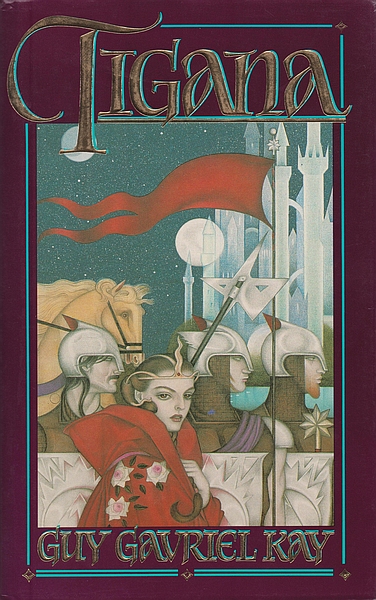
TIGANABy Guy Gavriel KayRoc0-670-83367-3673pp/$21.95/September 1990 |
|
Reviewed by Steven H Silver
In December of 1992, I received an advance reader copy of Guy Gavriel Kay's forthcoming novel A Song for Arbonne and read the book in a single day, falling in love with his writing. I picked up copies of the Fionavar Tapestry and read them. I picked up a copy of Tigana, and I picked up copies of each of his subsequent novels as early as I could acquire them and read them. Yet, for some reason, and despite its reputation, I never actually read Tigana. Having read Written on the Dark last year, and unsure when the next Kay novel would be released, I decided it was time to visit his first stand-alone novel, which has been sitting on my shelf for more than thirty years.The novels action takes place on a large peninsula known as the Palm, which is the home to nine provinces. Twenty years before the start of the novel, four of the provinces: Chiara, Asoli, Corte, and Lower Corte, were subjugated by King Brandin of Ygrath. Four of them: Astibar, Ferrault, Certando, and Tregea have been subjugated by Alberico, a nobleman from Barbadior, who sees his conquest as a stepping stone to the throne. The remaining province, Senzio, has managed to retain its independence, even as both conquerors eye it. While both conquerors seem similar at the beginning of the novel, from their goals in the Palm to their ability to wield magic, Kay slowly fleshes them out to show their differences. Alberico appears more brutal, more rash, and more bent on vengeance. His goals are not in the Palm, but in the world beyond the Palm. Brandin seems a wiser ruler, playing the long game and thinking through his actions, the Palm is an end, not a stepping stone. However, Brandin has also used his magic to brutally erase the memory of Tigana. Only those who lived there before the invasion can remember, speak, or hear its name. To the rest of the world, it is Lower Corte, which bore the brunt of Brandin's anger when his son was killed in battle there.
Even at the start of his solo writing career, Kay demonstrates an ability to build a complex world. the provinces of the Palm are not uniform, each having their own identities which are slowly revealed as his large cast of characters make their way through the provinces in search of their goal. Many of his characters are natives of Tigana, even if they aren't aware of it, and they are driven by the thirst to remind the world of their land and its culture. Alessan is the leader of a band of troubadours who might be more than he appears. Devin is a singer, recruited into Alessan's band along with the revelation that he was born in Tigana. In Chiara, one of Brandin's favorite concubines is also a Tiganan who is biding her time before she exacts a deadly vengeance on him. These rebels against the occupation, and similar rebels against Alberico's occupation, work toward their goals without having contact with each other or a complete picture of the politics of the Palm.
His characters are equally complex. When the novel opens, Alessan has teamed up with fellow Tiganans Baerd and Catriana, who are members of his musical troupe, although more about them will be revealed. A young singer, Devin, gets pulled into their circle. The characters don't always act in a rational manner toward each other, but Kay generally provides them with reasons for doing what they are doing. Dianora, King Brandin's concubine hints at her reasons for postponing her vengeance, but it isn't clear if she is really doing so because of fear of the punishment or because she has begun to see Brandin as more than just the person who subjugated her people. Their activities are also guided by the belief in the Triad, a god, Adaon and the goddesses, Morian and Eanna, the worship of whom by distinct priesthoods helps build the complexity of Kay's world.
If there is an area where Tigana shows weakness, it is the pacing. Between his adroit and careful world building and his focus on his characters, the plot of the novel, which seems as if it gets off to a quick start with the death of Sandre, Duke of Astibar, winds up taking a long time to really get going. This isn't helped by the fact that so many characters have secrets which they only begrudgingly, and realistically, give up to each other and to the reader. It is an issue that Kay quickly resolved as it is less obvious in his subsequent novels, which many to get the right quantities and mix of character, world building, and plot. At the same time, while all of his novels feel as if they are part of the fantasy genre, Tigana is one of the few with overt magic, and even then it tends to be performs off stage by the two conquerors and Erlein di Senzio, a mage who finds himself enslaved and forced into the battle for the Palm's domination.
Ultimately, Kay is able to pull everything together and provide a satisfactory conclusion, which makes Tigana a book that stands up well on its own and not just as an early representation of an author whose career has continued to grow. While reading Tigana after his other works, there are scenes that I recognized in this book as precursors of scenes that feature in his later novels. Tigana's strengths outnumber its weaknesses and it show a mature author who might still be working on his craft, but has already mastered most of the skills he needs to be a masterful storyteller.
| Purchase this book |
|
|
|
|
Paperback |
Kindle |
Audio book |