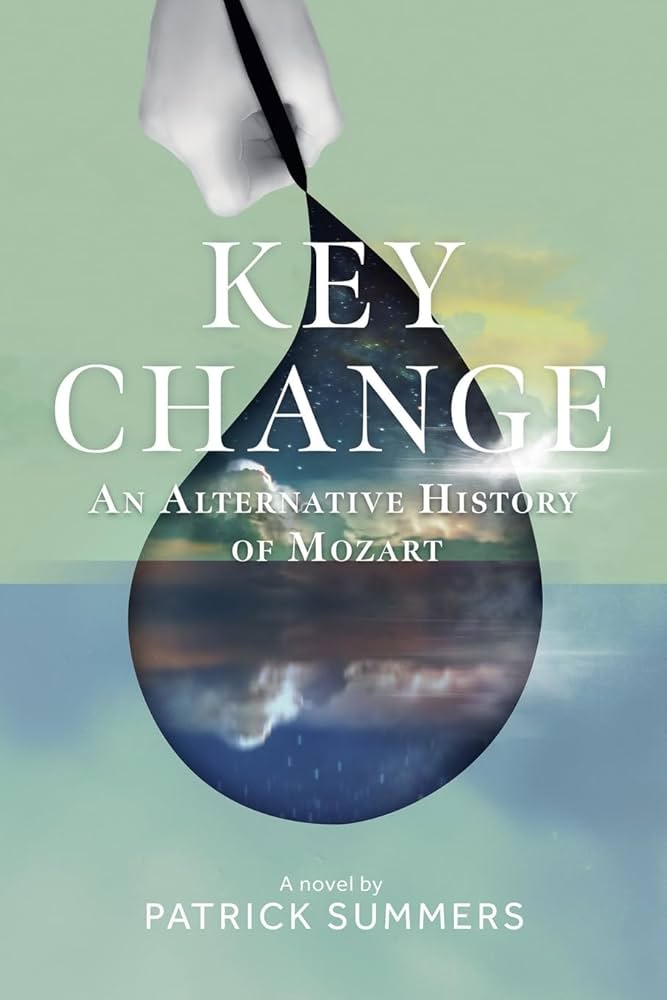
KEY CHANGEBy Patrick SummersContenti Press978-8-987-60231-7578pp/$24.99/January 2025 |
|
Reviewed by Steven H Silver
Patrick Summers has elected to grant Wolfgang Amadeus Mozart several decades more of life in Key Change: An Alternative History of Mozart. Written in the first person from an aging Mozart's point of view, he reflects on his music, his relationships, and the individuals who he came into contact with during his extended stay on earth. Summers' Mozart is well aware that he was on the verge of death in December 1791 and he believes that a Romani woman who cared for him during his illness died in his place. The book, therefore, is written by someone who is sure he has lived a life of borrowed time, guilty for the death of the woman who died in his place.Key Changes is more philosophical than many alternate histories. Rather than focus on the events of Mozart's extended life, Summers spends a good deal of the novel exploring the musings Mozart has concerning his existence, his music, his relationships, and the composers around him. This isn't to say he ignores what happens, as he shows Mozart's ability to write additional music, see his marriage to Konstanze fall apart, and show his rivalry with the next generation of composers, represented by Ludwig van Beethoven. Summers also pulls Mozart out of Vienna and introduces him to Paris, London and other places as he takes a role at the Court of George III and eventually moves on to additional opportunities.
The Mozart Summers present is a far cry from the version of the composer who appears in Peter Shaffer's play Amadeus. Although Summers' Mozart retains the sense of amusement at scatological humor, he is a much more mature and calm figure than Shaffer's version. He acknowledges his debt to Antonio Salieri and pays tribute to many of the composers who came before him, notable Bach, Haydn, and Handel, while viewing the up-and-comers, such as Beethoven, as wannabes and threats to his place in the field of music. Despite the success of his historical works, such as Le nozze di Figaro or Così fan tutte or his ahistorical works, like Richard III, Mozart lives in constant fear of being deemed inconsequential. Although Mozart doesn't put it in these terms, his attitude is a clear case of imposter syndrome that he must fight against.
Just as the young Mozart traveled around Europe finding patronage at the various courts, the adult Mozart also finds himself on the move. Leaving Vienna for London shortly after Joseph II's death, his position as the Master of the King's Musick to George III is also ephemeral and he finds himself transplanted to the Americas following an invitation from John Jacob Astor, a change presaged by an encounter with an African slave in Boulogne and encounters with partisans of Thomas Paine in England. The expanded scope of Mozart's life and travels, of course, influence his music, but also have a personal impact on him as he meets the love of his life in America.
While there is a chronological narrative element to Key Change, the majority of the book is filled with Mozart's internal musings as he looks back over his lengthy life. This has a distancing impact on the work. The reader doesn't feel present for the events Mozart does describe, instead understanding them only through Mozart's interpretation and biases. The references to Mozart's works which were written only in Summers' imagination is depressing as the reader can never hear the music this version of Mozart was able to compose in the decades following our Mozart's death. Due to the nature of Summers' writing, Key Change starts out slowly, but as the reader gets more accustomed to the style the novel picks up steam.
| Purchase this book |
|
|
|
|
Paperback |
Kindle |
Audio book |