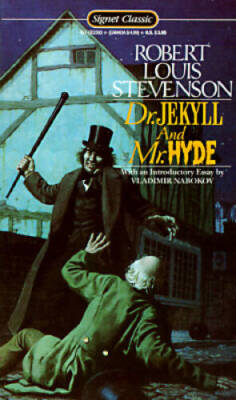
STRANGE CASE OF DR. JEKYLL AND MR. HYDEBy Robert Louis StevensonLongmans, Green & Co.141pp/January 1886 |
|
Reviewed by Steven H Silver
Certain novels have worked their way into the cultural consciousness to the extent that people who have never read the book (or seen the movies based on the book) are aware of the characters and situations, even if they don't know the specifics of the story. Reading those novels with expectations based on "common knowledge" can be jarring and disappointing. One of those novels is Robert Louis Stevenson's 1886 novel Strange Case of Dr. Jekyll and Mr Hyde. Although the title characters are a focus of the novel, Stevenson's main character and narrator is Gabriel John Utterson, Henry Jekyll's attorney, who becomes concerned about his friend when he realizes Jekyll has formed some sort of connection to the unsavory Edward Hyde.Utterson first becomes aware of Hyde when his cousin tells him about witnessing Hyde collide with a young girl and trample her. The cousin demanded restitution from Hyde for the girl's injuries and commented that Hyde has some sort of deformity and an evil face. He was surprised when Hyde makes part of the payment with a check drawn on Jekyll's account, although the bank confirms it is legitimate. Utterson is concerned that Hyde is blackmailing Jekyll, who has recently changed his will to favor Hyde. The novel focuses on Utterson's growing fears about Jekyll's well-being and neither title character spends a lot of time directly interacting with anyone. Eventually, Stevenson reveals what is happening, not be depicting an encounter between Utterson and Jekyll or Hyde, but rather with lengthy letters written by Hyde which explain what has been happening beyond Utterson's view.
Strange Case of Dr. Jekyll and Mr. Hyde is a Victorian novel, which, of course, means it is written in a formal, almost stilted language. Paragraphs are long, often stretching for a full page or longer. Stevenson often waxes philosophical on good an evil, which is at the heart of the novella, with Hyde Jekyll representing the Ego and Hyde the Id nearly four decades before Freud introduced the concepts. Jekyll, it is revealed, struggled with the idea of evil in mankind and how it could exist alongside good and his experiments to free his good side from his evil side wound up releasing itself as Hyde in a physical manifestation of that evil, but one for which Hyde continued to feel responsible, realizing that it was part of himself.
Unfortunately, the concept of the split between Jekyll and Hyde is more interesting than the actual novella, which may be why adaptations on stage, screen, or literature often add subplots, change the appearance (or size) of Edward Hyde, and otherwise build on the basic ideas outlined in Stevenson's final chapter to augment Utterson's understanding of the crimes committed by Hyde. Even if some of the ideas introduced by Stevenson in his exploration of good and evil are timeless, the novel containing them feels dated in both language and structure.
| Purchase this book |
|
|
|
|
Paperback |
Kindle |
Audio book |