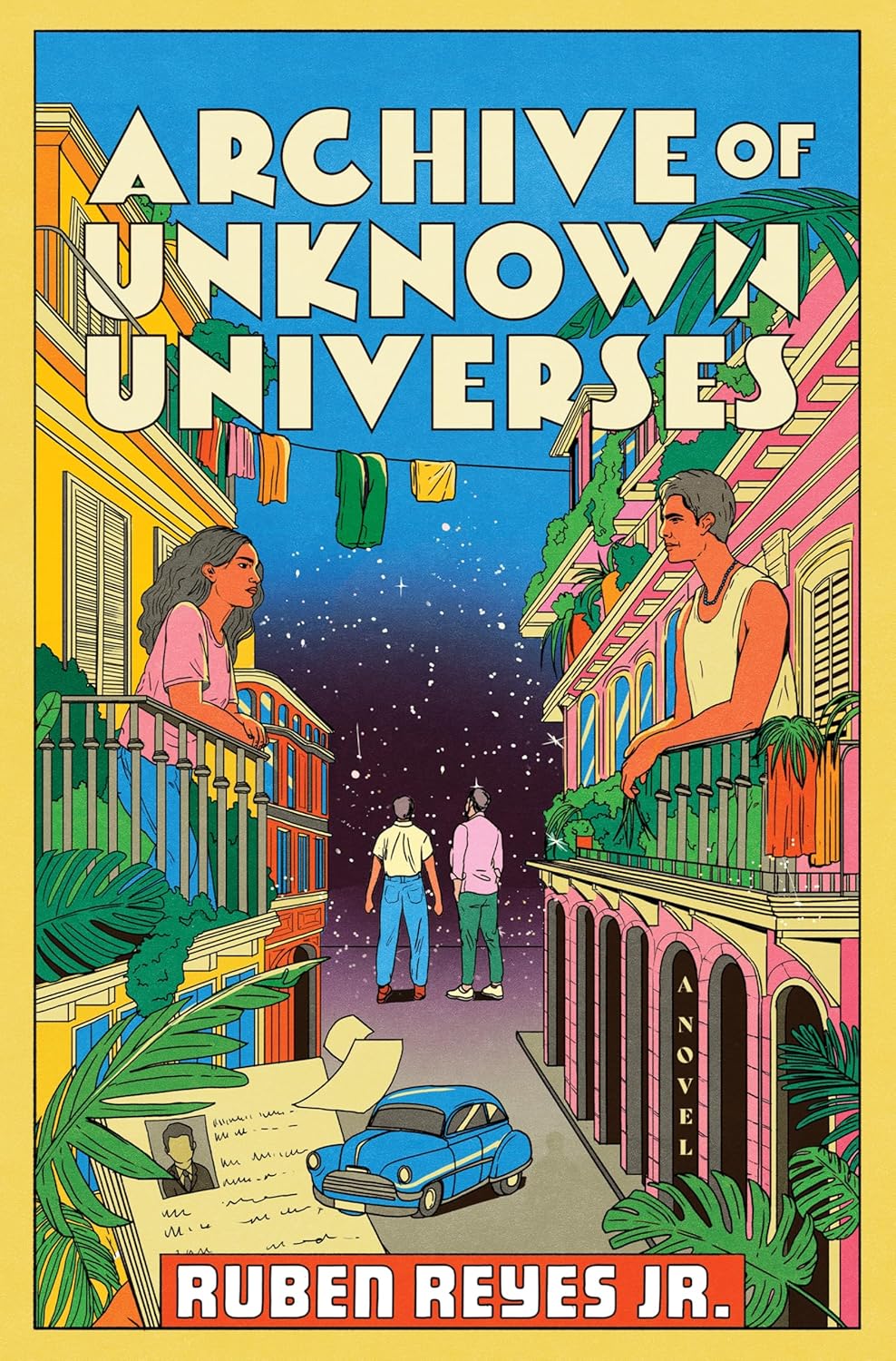
ARCHIVE OF UNKNOWN UNIVERSESBy Rubem Reyes, Jr.Mariner978-0-06-333631-5280pp/$28.00/November 2025 |
|
Reviewed by Steven H Silver
Ruben Reyes, Jr. offers a complex multiverse in the evocatively titled Archive of Unknown Universes. He introduces Ana, a graduate student who is dating Luis, although their relationship is not entirely stable. One of the issues is that Ana embraces the use of a technology known as a Defractor, which allows users to catch glimpses of alternative worlds, which Luis views as dangerous. When one of her illicit uses of a Defractor seems to indicate a world in which she is dating Domingo, Ana begins to questions her own reality. At the same time, Reyes introduces Neto and Rafael, revolutionaries in 1970s El Salvador, who have a tie to Ana.Reyes isn't particularly interested in how the Defractors work, although the hints he drops are interesting, with the user asking the question, specifying whether the answer should be visual or textual, and most confusingly, seemingly offering unrelated trivia to the user. These sections are set apart in the text by gray boxes. While Reyes doesn't go into detail about the Defractors, their ole of introducing the various different histories make them a crux to the novel, even if it appears that the narrative is following the actual events rather than the events as depicted by the Defractors, which is there to provide hints, sometimes convoluted ones, to Ana and other users of the Defractors.
Reyes assumes a certain amount of knowledge and understanding of the revolutionary movements in Central America during the 1970s and doesn't always provide the background necessary for the reader to understand the difference between the movements in El Salvador or Nicaragua. When dealing with three timelines, jumping around in the chronology, and offering different versions of Neto, Rafael, Ana, Eliza, and his other characters, Reyes has created a complex, and not always coherent set of histories for his characters. The fact that the revolutionaries won in one version of history and lost in the other, also tends to muddy the waters as Reyes' narrative jumps back and forth between the timelines.
Although the different timelines are important, Reyes real focus is on the different relationships in the various timelines. Not just whether Ana is with Luis or Domingo, but how Neto and Rafael's relationship plays out. In one version of reality, they can be true to who they are, while in another, Rafael feels he must hide who he is. This basic shift in identity for Rafael has implications in the future timelines that he and Neto can't foresee and which can only be explored because the Defractors allow for the study of multiple timelines and Reyes can jump from one version of history, and his characters, to another. An interesting feature of the duality of the characters is seeing how Angst-ridden Rafael can be when he must hide aspects of himself.
While most alternate histories tend to focus on one outcome, Archive of Unknown Universes explores multiple versions of the world without feeling the need to designate any one timeline superior to any other. Providing more clues about how the timelines Rafael, Neto, Ana, and the others inhabit differ from our own timeline would help make the book more cohesive, since without it the reader is tempted to brush up on the history of El Salvadoran revolutionaries in the middle of the narrative to find out how things differ, but at the same time Reyes is to be commended by for not spoon feeding his readers in an unrealistic manner.
| Purchase this book |
|
|
|
|
Hardcover |
Kindle |
Audio book |