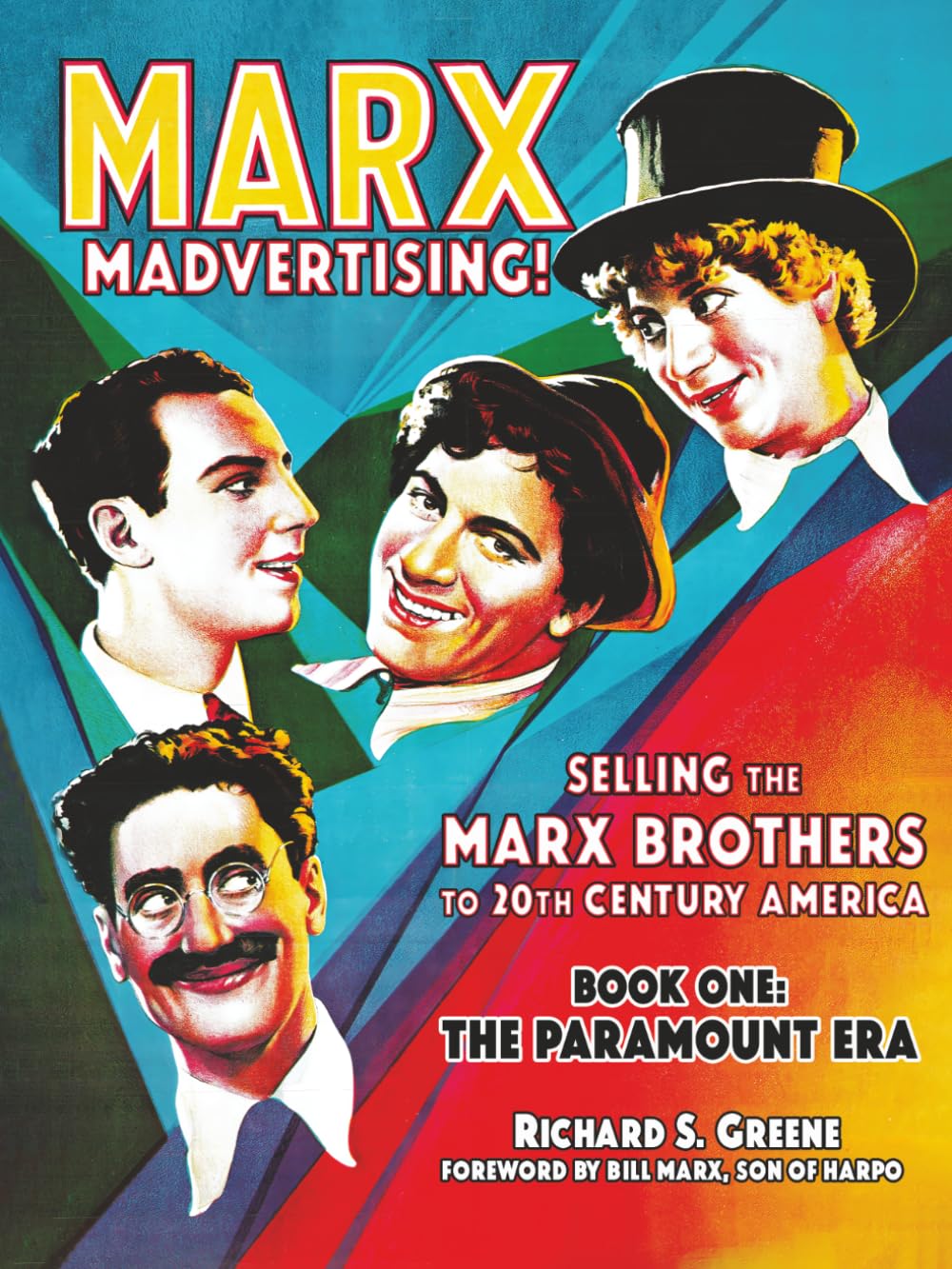
MARX MADVERTISING!Selling the Marx Brothers to 20th Century AmericaBook One: The Paramount YearsBy Richard S. GreeneBear Manor Media978-8-90535-021-4470pp/$99.00/June 2026 |
|
Reviewed by Steven H Silver
In this age of Blu-Rays and streaming media, it is sometimes hard to remember that for the first century of films, they were mostly considered ephemera. Not as much as a play, which only exists for the duration of the performance, since film captures performances, but still ephemeral since they could only be watched when studios chose to release them (or later showed them on television). In Marx Madvertising! Selling the Marx Brothers to 20th Century America: Book One: The Paramount Years, Richard S. Greene presents the ephemera the promoted the ephemeral films: Press kits, lobby cards, advertisements, and similar items meant to be see in the moment and then discarded.This first volume not only contains the five Paramount films that opened the Marx Brothers' joint cinematic career: The Cocoanuts, Animal Crackers, Monkey Business, Horse Feathers, and Duck Soup, but also their last two films, A Night in Casablanca and Love Happy. Each chapter on the films opens with a background of the film, a brief synopsis of the movie, and a description of the ad campaigns and press response to the movies. Greene discusses specific pieces of advertising in these essays, which would have been made stronger if he has specified the page the images appeared on (or otherwise linked them), rather than make the reader hunt for the art he is discussing. The majority of this section, however, is taken up by color reproductions of posters, lobby cards, ads, pins, and movie stills.
The ads Greene reproduces show a lot about what spoke to the movie-going public from 1929 when The Cocoanuts was released through 1949 when Love Happy was advertised. The changes in the imagery, especially between those two films, also demonstrates how the printing technology changes over the two decades, with the use of color and detail in the later ads much better and more sophisticated. At the same time, the portraits of the Marx Brothers also changes, from the caricatures for the early films which helped introduce the brothers to the later drawings which were not introducing the brothers, but rather reinforcing the popular images and personae of the brothers and their characters. At the same time, while the brothers were front and center in all the pieces for the early movies, the ads for A Night in Casablanca and Love Happy feature ads which focus on their female co-stars: Lisette Vera for the former, and Ilona Massey, Marion Hutton, Vera-Ellen, and even the then-unknown Marilyn Monroe for the latter. Given the amount of product placement in Love Happy, it is only fitting that the film was also used to advertise other products, like Baby Ruth bars, tires, and cigars, in print.
Greene's book isn't content to just focus on the films. He also has a section which looks at the brothers (collectively and individually) on radio. Although Flywheel, Shyster, and Flywheel are mentioned in Greene's introduction to the section, the majority of the ads are for guest appearances by Groucho and Chico on various radio shows, such as the Pabst Blue Ribbon Radio Program or Five-Star Theatre. Many of these show them with other actors and feel even more ephemeral than the film advertisements. The section ends with a reproduction of a ticket to a radio show Chico was hoping would be picked up: Chico's Barber Shop. From radio, Greene goes to general publicity materials, including what look like headshots. These pictures, even the headshots, seem to capture the personalities and zaniness that the brothers wanted to portray, Facing a reasonably straightforward headshot of Zeppo, Greene includes a full body shot of him that may have been taken at the same photo session, with a sideways grin that speaks of mischievousness. In these pictures, all the brothers, but especially Harpo, demonstrate that any item can become a comedy prop in the right hands.
Finally, Greene looks at the use of the brothers in advertisements, an expansion on the earlier ads featured in the section on Love Happy. In many cases, the ads are simply the brothers allowing their images to be used to promote cars, beer, or peanut butter (and Groucho appears more frequently than his brothers). In other cases, Greene includes sheet music the brothers appear on because they performed the song in films, stage, or radio. The Groucho cocktail napkins are featured, as is the Groucho TV Quiz Game and the You Bet Your Life board game. Various book and record covers are also included, showing the books Groucho and Harpo wrote as well as the records Harpo released. Finally, Greene ends with a preview of reproductions which will appear in the second volume, which will cover the MGM and RKO films and their television careers.
Greene's text is informative and offers an excellent look at the state of advertising for each of the films, but the real focus of the book are the reproductions, which are clean and easy to explore. Captions offer context and it is interesting to see the different artistic styles, even when they were drawn in a manner Greene describes as "the most horrific movie poster of the 1930s, a decade that gave us Dracula, Frankenstein, The Mummy, and Dr. Jekyll and Mr. Hyde." Greene offers plenty of images to explore while waiting for the promised second volume, but also makes the reader wish Greene had found a way to include similar advertisements and ephemera from the brothers' Vaudeville and Broadway careers.
| Purchase this book |
|
|
|
|
Hardcover |
Paperback |
Kindle |