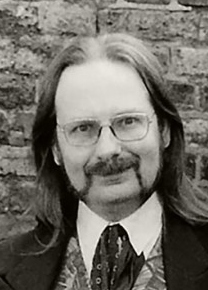
Kim NewmanInterviewOriginally published September 1999 at Steven Silver's Website |
|
Interviewed by Steven H Silver
This interview was conducted as part of a publicity campaign for Al Sarrantonio's horror anthology 999, in which several reviewers and interviews on diffferent websites were asked to interview one of the contributors to the anthology. I was reviewing for SF Site at the time and was connected with Kim Newman, whose story "Amerikanski Dead at the Moscow Morgue" was included in the anthology."Amerikanski Dead at the Moscow Morgue" opens the Al Sarrantonio anthology 999. In it, the zombies of Americans keep crowding the morgue in a war-torn Moscow. Do you feel the themes of this story are linked in any way to the ideas you and Eugene Byrne play with in the Back in the U.S.S.A. stories?
Only insofar as there's a Soviet setting and a crazy quilt cold war backdrop, and Rasputin appears as a presence. The tones of the pieces are quite different, I think. In 'Amerikanski', I was trying for an unusual style: no dialogue, blocky chunks of prose, a Russian sense of ennui rather than American hysteria.
Many of your stories, such as "Amerikanski Dead at the Moscow Morgue," have the battle between socialism and capitalism at their core. Do you feel that socialism (in a Marxist context) can be revived or has it become a part of twentieth century history?
There's still China, and Cuba. I wouldn't write off a belief system as monumental as Marxism too swiftly. I think of myself as a Libertarian Socialist rather than a Marxist. The difference between the belief systems seems to me that capitalism is proud of being inherently corrupt and evil, whereas socialism -- as opposed to Stalinism -- at least has the decency to be ashamed of the failings of its various experiments in government.
Many of your short stories have been published or reprinted on the internet. Do you feel these stories are received any differently by the reader because they can be read for free?
I don't think it's actually that many (4 and a half, by my count, and three in one archive). I've only published one piece directly on the Net, "Andy Warhol's Dracula," and that came about because two people approached me asking for a novella and it was worth doing if they could agree to share rights. It'll be coming out as a chapbook in the UK soon.
Do you find you receive more immediate and constant feedback on web published stories?
No. In fact, I haven't had any feedback at all.
Do you feel that web publishing will ever replace the more traditional means of publishing or will it only be a minor adjunct?
As a working writer, I have had to read entire novels off a screen and there are some major technical bugs to be ironed out before reading from a computer will be anything like as pleasant as reading a book.
The tenor of the Anno Dracula series has changed between the publication of Anno Dracula and "Andy Warhol's Dracula." How has the symbolism of vampirism changed for you as you've written the series?
I suppose I've got fed up with writing the bite scenes, which are the curse of all vampire fiction. The cycle is an attempt to explore every possible metaphorical reading of vampirism, so each installment is necessarily about something different. I suppose the overall image is of vampirism as exemplar of all the bad things people do to each other.
Will you be writing more Anno Dracula novels or short stories?
"Coppola's Dracula" and "Andy Warhol's Dracula" constitute about half of a projected wrap-up novel in the series, Johnny Alucard, which will take us to about 1988 and thus mean the cycle covers a full century. After that, I'll let it rest at least for a while.
You've collaborated with Eugene Byrne on several short stories and the book Back in the U.S.S.A. How do your collaborations with him work.
Usually, we outline together, Eugene writes a first draft (with gaps) and I do a polish (filling in gaps). We have done one story the other way round ("Citizen Ed"), and on longer pieces and the novels we have sent stuff back and forth so each gets to first draft a chunk and revise the next.
Have you written the last of the Back in the U.S.S.A. stories or will there be more?
That story is probably told. I like the idea of the whole of it being available in one book. There is also a sense of closure in the twinning of the first and last stories.
You and Byrne are currently working on a series you call "The Matter of Britain." Can you give me an high level synopsis of the series?
It's a Nazis-Won-the-War series, consisting of six volumes, set from the 1940s to the turn of the century, each complete in itself, but making up a big, multi-generational soap opera like Heimat1:45 PM 1/28/2026. The first book, which is drafted, is about the discovery of a sword which might or might not be Excalibur in the West of England, and the uses made of it by a range of people from a German archaeologist through an SS man and a resistance leader to a housewife trying to get by. Subsequent books will revolve around different things: the next one is Olympiad, set at a London Nazi Olympics in the 1950s. The 70s book has the projected title Saturday Night Fuhrer.
Do you have a target publication date?
No. The first novel is complete, and we're looking for a deal on it and the rest of the series. It may take a while to sort everything out.
You mentioned "The Matter of Britain" in several places on Usenet and in Listservs as well has having a website for it. Why are you creating this novel in such a public manner?
The website is for Eugene and my work in general, not just this project. We thought it might be an interesting experiment to work this way. We may well not have thought it through. Having done all the work, we thought it might be nice for those interested to share it. We got at least as much grief as appreciation, so we'll be reassessing the policy.
Have you received useful feedback from people who have look at "The Matter of Britain" Web Site?
Eugene tells me he's had a flow of nit-picks about the outline of history we posted, to the point that we're going to take it down. It's all background stuff that may change or become unimportant and having to argue about it just hinders work on the important business of the novel itself. Lengthy debates about the number of troop-carrying barges Hitler could have assembled in 1940 really doesn't help much when it comes to working out a gripping story, rounded characters or exciting themes.
History plays an enormous role in your writing. What is it about the past that interests you so much? Do you have any formal historical training?
Eugene is the historian; I'm an English graduate. I read a lot of history, and I tend to write big-ish stories with resonance beyond the domestic (though I've done smaller projects; the novel I'm working on now is a ghost story with a family and a house at its centre) and that means inevitably involving history or current events. Most of my work addresses my times as well as the ages: Anno Dracula is as much about the 1980s as the 1880s.
Your stories frequently incorporate popular culture. Do you do this as a shorthand to illicit certain reactions from the reader, as an in-joke, or because the specific reference means something within the context of the story?
My field of expertise may well be pop culture, though I'm comfortable with high culture too (a lot more Anno Dracula readers like the Kolchak joke than the E.M. Forster one). Some of the references are just wallpaper to establish mileu, and some are just for fun, but on the whole I use this material to make a point, either to evoke a specific time or place or to establish character. You learn a lot about a person from poring through their record collection, magazine rack or fridge, and I often use that method of detailing who people are.
| Return to |