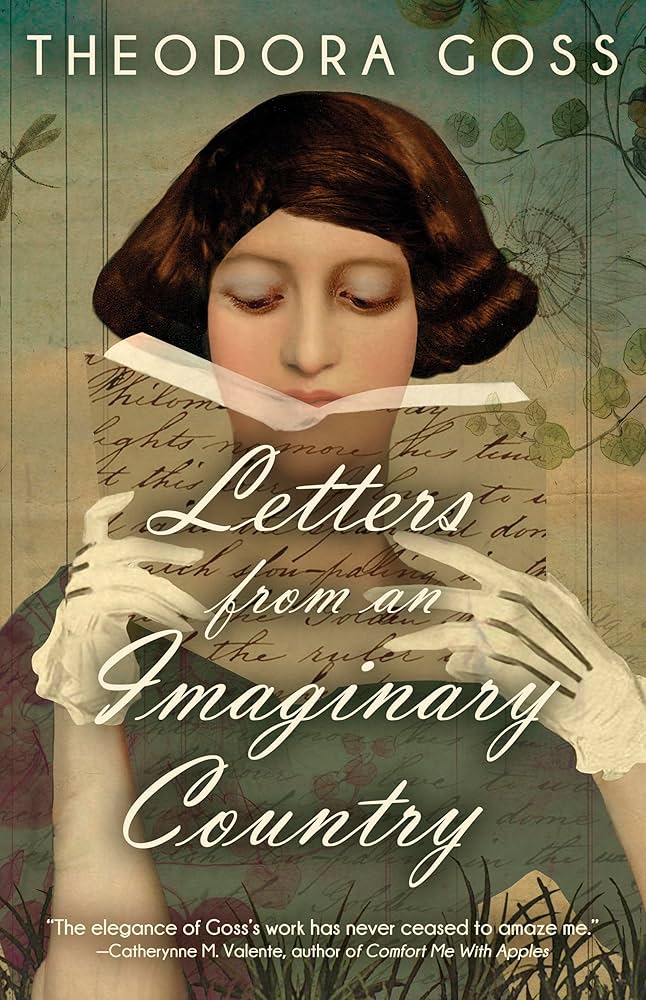
LETTERS FROM AN IMAGINARY COUNTRYBy Theodora GossTachyon Press978-1-61696-440-5340pp/$18.95/November 2025 |
|
Reviewed by Steven H Silver
The first things one notices of Theodora Goss's latest collection, Letters from an Imaginary Country, is how wonderfully evocative the title is. Even before opening the volume to the first story, "Mad Scientist's Daughter," the potential reader has images of a world that doesn't exist, but is full of wonder and strange customs. The book invites you to open it up as a Frommer's guide to the countries of Goss's imagination.Two of those countries that are invoked are Cimmeria and Pellargonia, each of which are escribed in their own stories that are written as articles published in the Journal of Imaginary Anthropology. In "Cimmeria: From the Journal of Imaginary Anthopology," Goss introduces a group of college professors who have created the country of Cimmeria as a group project to use their various disciplines to see what kind of country they could create, only to discover that once it has been published in the journal, the country began to exist and they were invited to the country to study its culture more closely in a way that would change their lives. Something similar happens in Pellargonia: A Letter to the Journal of Imaginary Anthropology where a group of students so something similar, only to discover that the country has also become real, and more detailed than they imagined when news articles about the country begin to appear.
in the volume's title story, originally published in this book, Goss has also created the northern European country of Thule, a former Soviet republic on whose folklore a fictional version of Goss focuses her studies. When a new regime takes over, Goss begins to receive letters and emails from friends warning her of the situation as it moves toward fascism. After Goss accepts an award for her work at the urging on one of her Thullian friends, the situation becomes worse, with some friends arrested and letters beginning to arrive from the heroes of folklore Goss studies. The letters reveal how various sides in a nationalist conflict use and appropriate traditional history and legends in order to bolster their claims.
Four of the stories, "England under the White Witch," "Frankenstein's Daughter," "Lost Girls of Oz," and "The Secret Diary of Mina Harker," use a springboard from modern literature. "England under the White Witch" offers Jadis from Narnia as a conqueror following World War I and explores how easy it is to fall thrall to an authoritarian leader, but also the dangers inherent in supporting a totalitarian regime. In "Lost Girls of Oz," Goss related the story of a Eleanor Dale, newspaper reporter who is trying to discover what is happening to girls who have disappeared from San Francisco in an epistolary manner. Goss's version of Ozma has a militant nature, which is used to attempt to achieve security for the Land of Oz. Goss has written about Frankenstein's creature and Dracula in various novels, but the versions she includes in these stories are different, showing how one person can explore the same source material in different ways. "Frankenstein's Daughter" focuses on Shelley's English explorer Robert Walton, positioning him as sympathetic to Victor Frankenstein as he falls in love with the woman who cares for him after he is rescued from the arctic. "The Secret Diary of Mina Harker," which includes sixty footnotes, explores the internal inconsistencies of Bram Stoker's Dracula, suggesting that Mina was working with Dracula from an early part of the story, offering a strong deconstruction of the novel. The footnotes extend the story by hinting at the events which follow her story.
Goss often writes with a first person narrator. Since many of her protagonists appear to be loosely based on her own life, it is easy to fall into the trap of thinking the stories, or at least her narrator, is autobiographical, however Goss obliquely counters that concept in "Dora/Dora: An Autobiography," which posts a personal alternate history for versions of herself and compares her life growing up in her native Hungary with the life of a version of herself that did emigrate to the United States as a child. Similarly, "To Budapest, with Love" offers a fictional autobiographical love letter to Budapest, perhaps telling the reader less about Goss's own life, but making clear her feelings for the city.
Letters from an Imaginary Country ia a fabulous collection, in both the sense the the stories are wonderful, but also that they evoke the sense of the fable. Goss's created worlds, whether Cimmeria, Thulle, or Budapest, are inviting and well realized, offering a folkloric quality. The volume serves as an excellent introduction to Goss's work with indications of the themes and topics she uses in her novels for those who wish to further explore her worlds.
| Mad Scientist's Daughter | A Letter to Merlin |
| Dora/Dora: An Autobiography | Estella Saves the Village |
| Cimmeria: From the Journal of Imaginary Anthopology | Pellargonia: A Letter to the Journal of Imaginary Anthropology |
| England under the White Witch | Lost Girls of Oz |
| Frankenstein's Daughter | To Budapest, with Love |
| Come See the Living Dryad | Child-Empress of Mars |
| Beautiful Boys | Letters from an Imaginary Country |
| Pug | The Secret Diary of Mina Harker |
| Purchase this book |
|
|
|
Paperback |
Kindle |