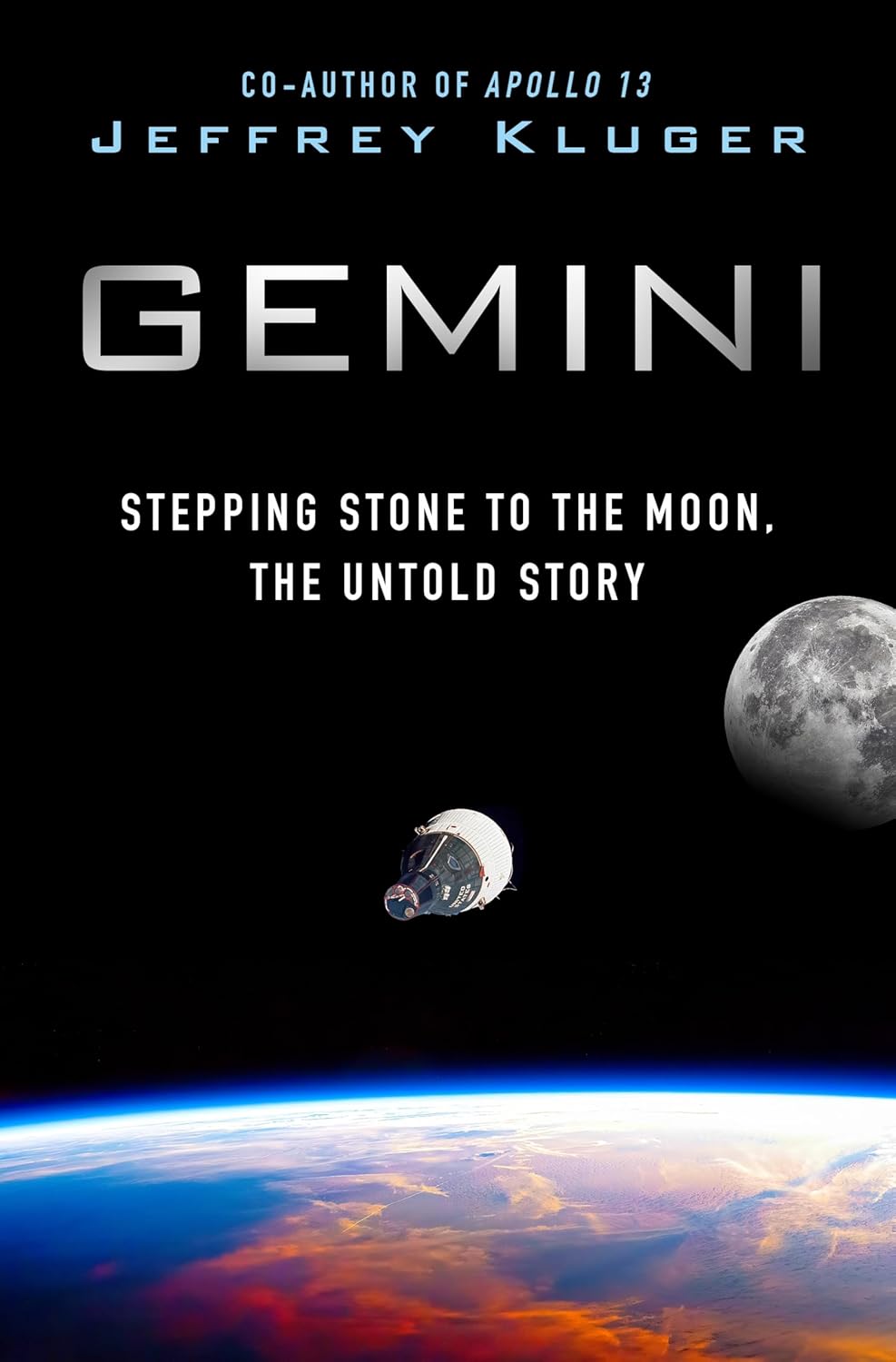
GEMINIStepping Stone to the Moon, the Untold StoryBy Jeffrey KlugerSt. Martin's Press978-1-250-32300-2288pp/$32.99/November 2025 |
|
Reviewed by Steven H Silver
The first three manned American space programs were Mercury, Gemini, and Apollo, often lumped together. Most people know the Mercury missions because of Tom Wolfe's The Right Stuff and the film based on it. Many know Apollo through Andrew Chaikin's A Man on the Moon or Tom Hanks' miniseries From the Earth to the Moon, based on Chaikin's book. As Jeffrey Kluger points out in his introduction to Gemini, there has not been an extensive single exploration of the Gemini program, which broke ground in ways Mercury couldn't and which allowed the U.S. to succeed with Apollo. Although twelve* of the astronauts involved in Gemini have written books about their experiences, nearly all were involved in Apollo, which tends to overshadow their accomplishments in Gemini.In fact, a good portion of the book deals with the Mercury program and the establishment of NASA, with Kluger giving detailed descriptions of the various Mercury flights (as well as the early Russian flights). Although the decision making process concerning the Gemini project is woven, in, he really doesn't begin to focus on the development of Gemini until more than 100 pages (more than a third of the way) into the book. THe effect of this is the feeling that a large part of the book is an introduction to the book's actual topic. Once Kluger does begin to talk about the development of the Gemini spacecraft, it feels as if he has finally gotten to his subject matter. However, he does gloss over the involvement the astronauts had in the development of the spacecraft. Mostly, Kluger introduces an individual astronauts when he discusses their mission, but the astronauts were constantly visiting the companies which were designing the spacecraft to ensure they were being build safely and to specifications. Gus Grissom was so involved that the Gemini was nicknamed the "Gusmobile," a reference which is missing from the book. The closest Kluger comes to discussing the astronauts involvement is when he discusses Elliott See and Charlie Bassett's fatal crash at the McDonnell plant in St. Louis.
Most of the missions have a chapter dedicated to them in which Kluger introduces the astronauts assigned to the primary and backup crews, discusses the mission objectives and the issues the missions faced both in the planning stages and during the missions. He doesn't shy away from airing NASA's internal conflicts, either about the missions or the interpersonal conflicts, although when discussing the aftermath of Scott Carpenter's Mercury flight, he tends to rely more on Chris Kraft's account in Flight than Carpenter's response in For Spacious Skies. Grissom's decision to reject Frank Borman in favor of John Young for the Gemini 3 flight is dealt with succintly,, leaving the reader wishing more details were provided.*
However, his pacing still seems awkward. The epilogue discussing the Apollo missions is significantly longer than the final chapter, which lumps the Gemini 10, 11, and 12 missions in together. By spending so much of the book discussing Mercury and Apollo, Kluger seems to undercut the importance of the Gemini program in teaching "the US to live in space, to work in space, to walk in space, to thrive in space."
Coincidentally, two months before Kluger's book was published, Andy Saunders published Gemini and Mercury Remastered, an oversized collection of photographs taken during the Mercury and Gemini missions. While Saunders' captions are somewhat minimalistic, the book does provide an excellent companion piece to Kluger's volume, which includes several pages of photos which only hint at the grandeur of Sanders' reproduction. Kluger includes sixteen pages of photos in Gemini, eight in black and white and eight in color. These pictures provide a visual record of what Kluger is describing throughout the book, showing the hardware that was eventually developed (if not pictures of the development phases and abandoned technologies) as well as the individuals whose exploits and personalities he describes.
Ultimately, Gemini is an unsatisfying exploration of the Gemini program. When focusing on the specifics of the Gemini project and the individuals involved, the book hits the mark, but so much looks at Mercury and Apollo while ignoring much of the astronaut's involvement in the design of the Gemini, at times it feels like a more general study of the U.S. manned space program of the sixties than specifically of the Gemini program.
*Grissom doesn't discuss this change in Gemini, Borman says in Countdown that he doesn't know what went wrong, but after talking at Grissom's house for an hour he found he was off the mission. In Forever Young, Young comments that Borman told Deke Slayton that he couldn't fly with Grissom.
| Buzz Aldrin | Magnificent Desolation, First on the Moon, Reaching for the Moon, Return to Earth, Men from Earth, No Dream is Too High, et al. |
| Neil Armstrong | First on the Moon |
| Frank Borman | Countdown |
| Gene Cernan | The Last Man on the Moon |
| Michael Collins | Carrying the Fire, Liftoff, and First on the Moon, et al. |
| Pete Conrad | Rocketman |
| Gordon Cooper | We Seven and Leap of Faith |
| Gus Grissom | We Seven and Gemini |
| Jim Lovell | Lost Moon (a.k.a. Apollo 13) |
| Wally Schirra | We Seven and Schirra's Space |
| David Scott | Two Sides of the Moon (with Alexei Leonov) |
| John Young | Forever Young |
| Purchase this book |
|
|
|
|
Hardcover |
Kindle |
Audio book |