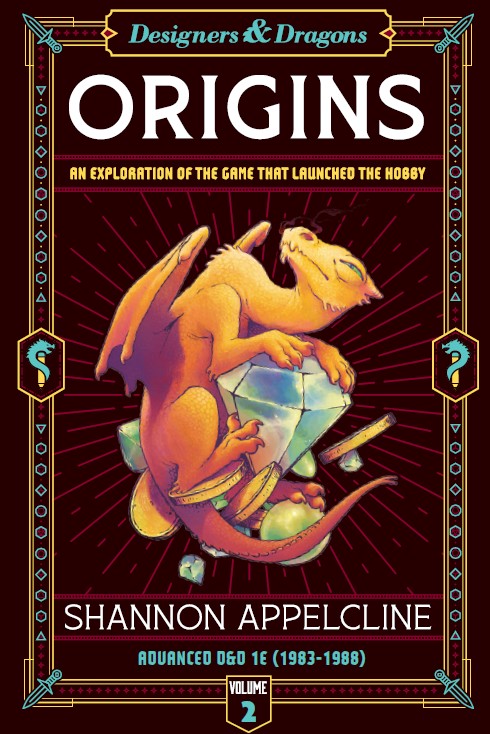
DESIGNERS & DRAGONS: ORIGINS, VOLUME 2By Shannon AppelclineEvil Hat978-1-61317-217-9400pp/$16.99/August 2026 |
|
Reviewed by Steven H Silver
While the first volume of Shannon Appelcline's Designers & Dragons: Origins is mostly chronological, the second volume of the series, which looks at the first edition of Advanced Dungeons & Dragons from 1983 through 1988, tends to stray from strict chronology in order to group things in common categories, which shows how much TSR was expanding the line during this period. As with the first volume, the book is made up of short chapters, each discussing a single publication. Also, as with the first volume, the most interesting chapters tended to be the ones for products with which I was familiar.Appelcline interspersing short sections about the creators throughout the book, usually immediately after mentioning their first work for TSR. While many of the stories are similar, an individual discovered war gaming, met up with people from Gygax's circle, and eventually found themselves working for TSR, there is also more variety in these stories than in the first volume. The creators here discovered Dungeons and Dragons and built their own campaigns, eventually finding their way to TSR through a variety of routes. Some, like Steve Perrin, came as freelancers with their own successes behind them, others, like Tracy Hickman, came with a world in their mind which they were able to sell, part and parcel, to the powers that be at TSR.
Appelcline's coverage of Hickman's Dragonlance and Greenwood's Forgotten Realms demonstrate the enormous difference between each of those worlds as well as Gygax's Greyhawk, and also makes it clear that Greyhawk could never have had the sort of background support or complexity that the Forgotten Realms had. Greyhawk was Gygax's world, and although he incorporated parts of the world from Dave Arneson and Rob Kuntz, but it was essentially his world. Even as he sketched out the world, he never explored it in depth. Hickman created Krynn in support of the story that he wanted to tell and almost immediately shared its development with other people. Although Greenwood created the Forgotten Realms, it was essentially crowdsourced to other creators, which meant it could be more fully fleshed out with the FR series of sourcebooks, the first seven of which are covered in this volume.
The first book mostly looked at rules and accessories, along with the early modules. This book looks at the modules. The ones set in no specific world, the major worlds of Greyhawk, Krynn, and the Forgotten Realms, but also the licensed worlds. Dungeons and Dragons had licensed the worlds of Robert E. Howard's Conan and Fritz Leiber's Lankhmar. Neither went far (during this period), with only three modules for Conan and a sourcebook and two modules for Lankhmar, but AD&D would eventually return to Lankhmar. TSR UK also achieved its high point during this period and has a lengthy section devoted to its post U series modules with many references to Imagine magazine.
Appelcline, again, does an excellent job. The articles are informative and interesting, especially for those modules and accessories I had in my playing days. I started reading the third volume, which details Basic Dungeons and Dragons, but stopped after reading about the Holmes box set and modules B1 and B2, since those were the only items in that volume that was part of my experience, I quickly moved on to AD&D, but reading about them reminded me of the haphazard way of learning to play in those days, when you would go from Basic to AD&D and the rules were not quite published, and the books certainly were not arranged to promote an ease of finding the rules. I realized we learned more about playing from Holmes and Gygax's examples of play than the rules and we learned to populate dungeons by filling in the blanks in In Search of the Unknown. For gamers from the 80s, these books offer a wonderfully informative sense of nostalgia.
Return to