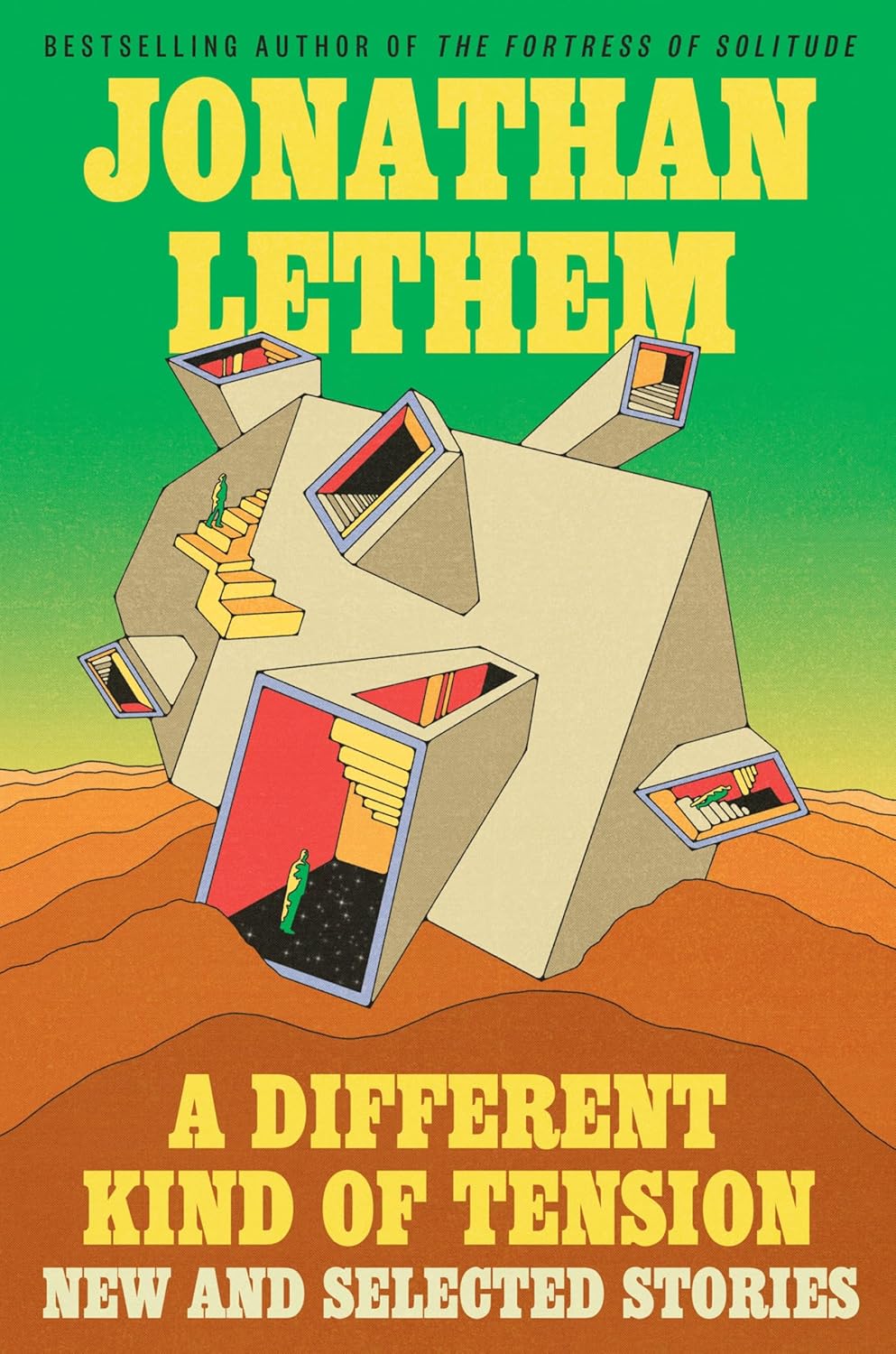
A DIFFERENT KIND OF TENSIONBy Jonathan LethemEcco978-0-06-338888-84-0400/$29.99/September 2025 |
|
Reviewed by Steven H Silver
Jonathan Lethem's collection A Different Kind of Tension collects thirty stories originally published between 1990 and 2024, making it a good retrospective of Lethem's career to this point. One of the stories, "The Red Sun School of Thought" is original to this collection. Lethem's decision to organize the stories in chronological order by publication further allows the reader to see his progression as a writer and the growth of the themes which he returned to in multiple stories, most notably the concept of community in a world in which isolation is rampant, if not desired."How We Got In Town and Out Again" is a post-Apocalyptic tale in which towns are seen as fortresses against the wilderness of the non-urban environment. In order to gain entry to a town, wanderers must demonstrate that they have something to offer. Lewis and Gloria are traveling on their own, two days from any meal and on the outskirts of a town. To get in, they hook up with another band of wanderers who prove to have something to offer the townspeople. Once in the town, Gloria and Lewis find themselves involved in a virtual reality game run by their new partners. Over the course of the game, they both come to the partial realization that while towns offer security against the outside, they also offer a whole new set of dangers. While the world Lethem creates for "How We Got In and Out Again" is interesting, it does raise several questions about the society and its infrastructure. Food and electricity are available in towns without a logistical way of appearing. The town he depicts is entirely self-sufficient, despite the greater world situation Lethem asserted, offering a sense of community.
"Sleepy People" is a story which doesn't attempt to explain its basic premise, which includes a post automotive world in which militia hang out in bars and teen aged gangs known as dinosaurs roam the street. Sleepy people appear to be some sort of narcoleptics whose presence can help plants grow. Judith Mapp finds a sleepy person on her porch and brings him inside. Tracking down the bar advertised on his t-shirt brings her to the attention of the local militia, of which her ex-husband is a member. The story never quite comes together as Judith seeks to understand her world, and the sleepy people, better, but never quite succeeds.
"Children with Hangovers" is a description of the narrator's neighbors, looking at the titular renters, the man next door, and others who live on his perimeter. There is a certain urban anonymity between the characters, reinforced by the lack of names, but at the same time, there is also a sense of community as the narrator knows about his anonymous neighbors, whether it is the cabbie who keeps late hours or the man with five flagpoles. Even if he doesn't speak to these people, he knows who they are and they seem to know who he is. Each living their own lives, if needed, they would come together to support their neighbors, returning afterward to their studied anonymity and semi-isolation.
Sigismund Blondy is a New Yorker who seems typical of many of Lethem's stories. Everyone knows him, yet nobody knows him better than he wants to be known. Ubiquitous in his circles, he only carefully controls how much each person sees of him, whether it is his accidental film-viewing buddy Grahame, who narrates this story, or "Lucky Alan" Zwelish, whose life Blondy has a strange interest in, no matter how much Zwelish cares about or for Blondy. As with "Children with Hangovers," "Lucky Alan" depicts a world in which anonymity and community can go hand in hand.
"Proximity People" is perhaps Lethem's purest look at isolationism among individuals. With no character or plot, it is a litany of individuals who push aside those people who are in front of them and trying to interact to focus on individuals who aren't there, and may not even exist. As the list grows, the sheer absurdity of the online lifestyle becomes central to the reader's understanding of the piece. A simple, and lengthy, list becomes a call to action to pay attention to the people close to you and in front of you and to live in the moment.
"Elevator Pitches" is less a story as it is a series of really bad ideas for television shows shared in short descriptions, as one would in an elevator pitch. The rapid fire descriptions build to project a black comedy made even darker by the knowledge that some of the pitches Lethem proposes could probably make it into production. In fact, some of the pitches could be quite entertaining while others could certainly describe shows that actually exist (such as "A bunch of people who work in the same building find one another mildly amusing, but not deeply interesting." Originally published in The New Yorker, it has the feel of a McSweeney's piece.
Lethem presents "The Afterlife" as a sort of bus terminal waiting room rather than a Pearly Gates heaven or a Kafkaesque Hell. His protagonist is aware that he is dead (or is he) and knows that he is on his way to the afterlife, but arriving in the waiting room, none of the souls there are given instruction. They mill around, hoping for something to happen, for guidance, while others continue to arrive, making the waiting room more crowded. Lethem's afterlife waiting room is almost a metaphor for life, where there are no instructions or plans and people just mill around trying to find purpose to fill up their time.
Originally published in The New Yorker in 2022 as "Narrowing Valley," "The Collapsing Frontier" is a response to R.A. Lafferty's 1966 story "Narrow Valley." While it isn't necessary to read the Lafferty story to enjoy Lethem's response to it, knowing the story does add depth and background to what Lethem is doing. "The Collapsing Frontier" is less of a story, but rather an author's musings on creating a story using an earlier work as a basis. The family depicted, or considered, in "The Collapsing Frontier" is clearly based on the family in "Narrow Valley," although it is never described well enough to show a one-to-one correlation. The author in "The Collapsing Frontier" also brings a more modern sensibility to the story than Lafferty had, considering including a form of land acknowledgement in the story. Not only is the author aware of the planning stages of the story, but the story being considered also seems to achieve a sense of sentience, taking the author's considerations to an irrational conclusion.
"In Mugwump Four" is an exploration of virtual reality and the reinforcement social media offers. The protagonist and his partner, Lucinda, have no interest in Mugwump 4, the virtual reality engine that so many of their friends are disappearing into. Instead, they live a relatively secluded life in the Italian countryside. The protagonist, however, feels the need to comment on virtual reality and decides to enter the program to issue a manifesto, leaving behind notes to help himself return to reality. He discovers that the instant gratification of people "orgasming" over his manifesto is addictive and he allows himself to explore the surreal world in which he finds himself. Eventually, he looks below the surface and realizes that while people love his manifesto, few have actually read it, focusing instead of the title, and he determines to return to reality, where he discovers things aren't as cut and dried as he thought.
The final story in A Different Kind of Tension is also the only original story in the collection. "The Red Sun School of Thought" is a coming of age story set in San Francisco in the 1970s, when a divorced boy finds himself shuttling between his mother's home in Oakland and the titular commune where his father lives in San Francisco. Looking back from the age of 60, he remembers a turbulent time for himself, not only is he dealing with his parents' divorce and a new school, he also is having to deal with puberty issues. The commune offers him aplace to try to fit in and meet people who are otherwise outside his experience, although since all the members are significantly younger than his father, he can almost imagine a friendship with them. In addition to showing his interactions with the commune members, and picking up on hints about what is happening behind the scenes, he also wants to know the secret behind the person only refered to as "The Founder." Although the Founders identity comes out of left field and hints at a future that the narrator never fully explains, but adds depth to the story and raises questions, which ultimately aren't important to the success of the story. While many of stories in A Different Kind of Tension deal with isolation, "The Red Sun School of Thought" is very much a story of becoming part of a community.
Not only does A Different Kind of Tension contains stories from more than thirty years of Lethem's career, but it also contains a variety of types of his stories, from relatively straight forward pieces to experimental pieces and gonzo pieces. He is able to demonstrate not only a continuity of themes, but also the manner in which his mind works sideways to the way our world is, presenting things in a new and unique light. Most of the stories are successful, and even the few that don't completely work offer the reader an interesting challenge.
| Walking the Moons | The King of Sentences |
| Program's Progress | Proximity People |
| The Speckless Cathedral | The Dreaming Jaw, The Salivating Ear |
| Forever, Said the Duck | Procedure in Plain Air |
| How We Got In Town and Out Again | The Empty Room |
Five Fucks  |
The Pron Critic |
| Sleepy People | Guy Bleeding All Over Skype |
| The Spray | Pending Vegan |
| Access Fantasy | Elevator Pitches |
| Children with Hangovers | The Afterlife |
| The Dystopianist, Thinking of His Rival, Is Interrupted by a Knock at the Door | The Crooked House |
| Super Goat Man | Narrowing Valley |
| Vivian Relf | To Visit the City of the Dead |
| Interview with the Crab | In Mugwump Four |
| Lucky Alan | The Red Sun School of Thoughts |
| Purchase this book |
|
|
|
|
Hardcover |
Kindle |
Audio book |