
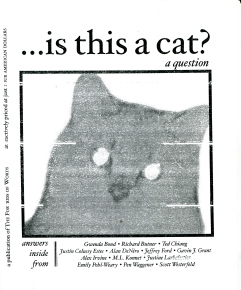
...IS THIS A CAT?Edited by Christopher RoweThe Fortress of Words48pp/$4.00/2002 |
|
Reviewed by Steven H Silver
The premise of Christopher Rowe's first publication from Fortress of Words, the 'zine ...is this a cat?, appears to be that Rowe asked several friends to answer that question with regard to a photograph of Rowe's cat, Portnoy. Some of the authors replied with short stories about Portnoy, while others sent drawings, non-fiction, or even a crossword puzzle.Scott Westerfield tells the story of a drunkard trying to get into a bar without identification in "Cat Years." He argues with the bouncer, pointing out that he is obviously older than twenty-one. His reminiscences of life to show he was alive in 1980 become more and more strange until Westerfield finally ties the drunk into the theme of the 'zine.
M.L. Konett's strangely named "Nakadamit ang bata na parang pusa" is the story of Jemma, a young girl whose mother appears to be both a hooker and a witch with a strange attraction for cats. Jemma, who is trying to assimilate herself into the neighborhood they have recently moved to, is hurt by the comments made by the locals as they gossip about her mother's strange ways. Rather than rebellion, Jemma tries to learn more about her mother's methods, resulting in a surprising discovery that she is more different than she thought.
Given Rowe's initial assignment of assuming that his cat, Portnoy, was not, in fact a cat, Ted Chiang responded with "Is This My Dog?: Delusional Misidentification Syndromes," a non-fictional account of Capgras Syndrome. While this could have been a dry recital of facts, the syndrome is so strange, and Chiang brings his wonderful writing talents to it, that it results in a very interesting piece which whets the reader's appetite for more information about this strange syndrome which may have been unknown before reading Chiang's work.
Jeffrey Ford breaks from Rowe's theme to present "Summer Afternoon," a story about auctorial inspiration. He takes an author suffering from writer's block and plays around with the various means he uses to come up with an idea he can write about, beginning with imaginary discussions with Henry James and eventually leading to an actual conversation with a publisher author. Given the general theme of the 'zine, Ford's piece, while well- written, seems out of place. Gwenda Bond has a couple of hard-boiled cat detectives trying to find out the answer to the 'zine's title question in "The Strange Case of Portnoy Rowe." As is the case with almost all the stories Rowe has included the line between human and feline is constantly blurred. While Bond's detectives seem clearly feline, her client is as questionable as Portnoy. The story is also laced with puns in a strangely humorless manner.
The center of the 'zine is taken up by Justin Colussy Estes's comic, "His Faster's Face." This is a simply drawn cartoon about a shapeshifter who appears, ultimately, to be a cat, although the question remains, "How can you tell?" "I Remember the Catsuit Kids" is an hallucinatory tale by Alan De Niro. While not having a specific plot, the story does manage to capture a feeling of quantum physics, which popularized the notion of Schrödinger's Cat. In this case, it isn't a living or dead cat within a box, but rather a cat or a child in a cat suit, as postulated by Kelly Link in a discussion cited in Rowe's introduction.
Justine Larbaleister looks at "Four Scenarios" which might answer Kelly Link's question of the identity of Rowe's cat Portnoy, only one of which, the last, depicts Rowe in a good light. The scenarios she spins are clever without trying to extract a story from the basically silly premise she was given.
Alex Irvine examines the life of an ultra-Jainist exterminator in "Who Might Be Called Scooter Hamelin." The story conflates the exterminator, Scooter, with the targets of his profession in much the same way that Link's comments conflated Rowe's cat with a child in a cat suit. While Irvine adheres to Rowe's premise, he does so loosely, and that freedom allows him to write a provocative story.
Richard Butner turns his attention to dogs rather than cats when the narrator of "Six Lines" snorts cocaine for the first time. Moreso than any of the preceding stories, Butner has elected to focus his attention on the sense of lost identity belonging to the cat in Rowe's question. The story is bitter-sweet, but one of the strongest tales in the 'zine.
| Christopher Rowe | Only This and Nothing More |
| Gavin J. Grant/td> | Letter to the Editor |
| Scott Westerfeld | Cat Years |
| M.L. Konnet | Nakademit ang bata na parang pusa |
| Ted Chiang | Is This My Dog? Delusional Misidentification Syndromes |
| Gavin J. Grant/td> | Interview Excerpt |
| Jeffrey Ford | Summer Afternoon |
| Gwenda Bond | The Strange Case of Portnoy Rowe |
| Emily Pohl-Weary | I've Never Liked Cats |
| Justin Colussy Estes | His Master's Face |
| Alan DeNiro | I Remember the Catsuit Kids |
| G.J. Grant/td> | Memo |
| Justine Larbelestier | Four Scenarios |
| Alex Irvine | Who Might Be Called Scooter Hamelin |
| Richard Butner | Six Lines |
| Reader's Choice |
Return to |
Reprinted from |
 .
.