
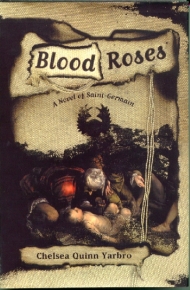
BLOOD ROSESby Chelsea Quinn YarbroTor0-312-86529-5511pp/$24.95/December 1998 |
|
Reviewed by Steven H Silver
Blood Roses is the twelfth volume in Chelsea Quinn Yarbro's Saint Germain Chronicles and it is becoming increasingly evident that Yarbro expects her reader to be familiar with Count Saint Germaine and his circumstances. This is really a shame since so many of the earlier volumes are currently out of print. In this outing, Yarbro has placed Saint Germain is the small Provencal village of Orgon in the middle of the fourteenth century, just in time for the first outbreak of the Bubonic Plague.
It may be assumed that this time, if not the place, is more familiar, historically, to Yarbro's readers than many of the more esoteric periods and places Saint Germain has dwelled. It is surprising, therefore, that fourteenth century France should appear to elude her writing abilities. This is one of the few novels in the series which really does not seem to capture the feel and attitudes of a specific period. Saint Germain, of course, continues to have twentieth-century sensibilities and knowledge in the world, but those around him do not seem particularly fourteenth century. Perhaps one of the reasons Yarbro fails to capture the feeling of the fourteenth century is that her narrative focuses on Saint Germaine and his Iberian-born ghoul manservant, Rogres. Her failure to provide a "local" viewpoint weakens the historical novel aspect of Blood Roses.
As mentioned earlier, Yarbro assumes the reader will know about Saint Germain's nature. This continues a trend which has decreased the role of his vampirism throughout the past several novels. Instead of being a "demon lover" or a creature of the night, Saint Germain has become a sensitive nineties kind of guy whose purpose is to provide pleasure to his lovers. References to his vampirism are limited to coy comments about his. . . blood and his need to wear thick-soled shoes. This also vexes because, while Saint Germain's attitudes should be affected by his long life, he should not be prone to attitudes which have not existed prior to the setting of the story, nor should he have knowledge which was unavailable prior to the setting.
Saint Germain's medicinal knowledge dates back to his centuries as a slave in the healing temple of Imhotep (chronicled in Out of the House of Life, 1990). The only detail Yarbro goes into really is his collection of a variety of herbs and his seeming belief that moldy bread, penicillin, is a cure for everything, up to and including the Bubonic Plague. While Saint Germain professes a desire to help as many of the dying as he can, he'll only help those who ask for his specific assistance with the result that he actually saves very few people. If a small lie would result in somebody accepting his help, Saint Germain refuses to tell them what they want to hear.
One of the nice things Yarbro does in Blood Roses is show Saint Germain in a non-noble role. Throughout the series of books, Saint Germain has commented on the many times that he has had to make his way in the world based on his musical abilities, however, aside from short scenes in which he performs as a nobleman (i.e. in Writ in Blood, 1997), Yarbro really hasn't demonstrated this to us. In Blood Roses, Saint Germain finds himself making his way across plague and war-torn France on the strength of his mandolla playing.
Another change from her normal plotting is the role of the villains in Blood Roses. Yarbro's antagonists are generally unremittingly evil men with sexual depravities. In Blood Roses, the main opponent is the Bubonic Plague. Saint Germain's human adversaries, such as Eudoin Tissant, the tax collector and later leader of the village of Orgon, come across as petty men who are trying to carve out a tiny spot for themselves in the world. Unfortunately, while it is nice to see Yarbro trying a different type of villain, these men come across more like angry gnats than like opponents worthy of Saint Germain's abilities.
The Chronicles of Saint Germain have been focussing more and more on the historical fiction aspect of the stories. While this is not a problem, and has probably extended the lifespan of the series, if Yarbro's novel doesn't stand up as an historical fiction, as is the case with Blood Roses, the books need to work as vampire novels. Yarbro's apparent resistance to continue to explore her character's vampirism means the book can not work on that level either. While it is not clear that Yarbro has reached the point where she should retire Saint Germain, she does need to decide if she is writing vampire stories or historical novels and focus on whichever decision she chooses to make.
Purchase this book from 
Return to |
Reprinted from |
 .
.