
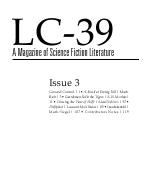
LC-39 #3Edited by Matthew Wells128pp/$6.00/December 2000 |
|
Reviewed by Steven H Silver
The history of science fiction magazine publishing is rife with stories of magazines appearing and disappearing in the twinkling of an eye.Unfortunately, LC-39 appears destined to be no more than a footnote in this history. In his opening editorial, Matthew Wells indicates that because of other duties, he will have to cease publication of LC-39 with the current issue. Unlike many magazines, his problems do not appear to be lack of interest or money, but rather lack of time. The quality of the stories in this final issue indicate that Wells was quite competent at producing a magazine that could garner a readership.
Mark Rich details one of the final nights on Earth for a paleontologist who has been selected to go on an expedition to Mars in "A Fossil at Evening-Fall." The story is mostly an internal dialogue as Lewis Fay suffers from last-minute remorse about the need to leave his entire life behind. Just as Rich's story seems to be entirely one of internal distress, Rich introduces the Fays' next door neighbour, and brings Fay back down to Earth.
A.R. Morlan tells the tale of a hacker who has been hired to discover the secrets encoded on a suicide's hard drive in "Guardsmen Fed to the Tigers." In the process, the hacker finds herself breaking into a coded puzzle, left on the drive by the former artist-owner, which serves as a sort of electronic psychologist, asking the hacker questions about her food addiction and obviously comparing it to the owner's own drug addiction and sense of hopelessness.
"Crossing the View of Delft" is an existentialist story in which Alan De Niro provides the reader with several basic assumptions about the two protagonists, Johannes Vermeer and Catha, and proceeds to demolish most of those assumptions, leaving the reader with a story completely different from the one originally presented, but one that is much more satisfying.
Laurent McAllister is the collaborative pseudonym of Canadian authors Yves Meynard and Jean-Louis Trudel. "Driftplast" is their seventh published story together, although both have published numerous stories under their own names. This story is the tale of the colonization of a new planet and the way in which the edenic dreams of the initial colonists go awry as they must deal with the realities of a less than perfect planet. The authors look at both the technical and sociological changes that must take place on the new planet, Holm, over the course of the first couple of generation if the colony is to have any hope of survival.
Mark Siegel's "Insubstantial" is also a story that starts out appearing somewhat disjointed, only to bring the disparate strains together by the time the story concludes. Initially the story of Ariel, an unsympathetic college student who is breaking off an affair with her art professor, Siegel intersperses her feelings of insubstantiality with depictions of the suffering the artist Dy Nath went through during the Cambodian killing fields. Eventually, Siegel reveals that Ariel's story is subordinate to Dy Nath's tale, and the real point of the story is the relative humanity of Dy Nath and his captor, Gao.
Editor Matthew Wells shows that he is capable of selecting stories that defy their own premises -- for which he is to be commended. Perhaps at some future time, when his professional duties permit him the time, Wells will have the time, money and inclination to resurrect LC-39.
| Mark Rich | A FOssil at Evening-Fall |
| A.R. Morlan | Guardsmen Fed to the Tigers |
| Alan DeNiro | Crossing the View of Delft |
| Laurent McAllister | Driftplast |
| Mark Siegel | Insubstantial |
Return to |
Reprinted from |
 .
.