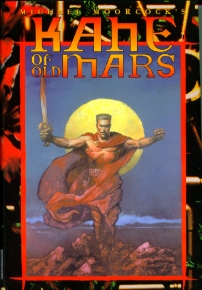
KANE OF OLD MARSby Michael MoorcockWhite Wolf1-56504-184-4450pp/$22.99/February 1998 |
|
Reviewed by Steven H Silver
Although Elric, Corum and Jerry Cornelius may be more famous, I've always through Michael Kane was one of Michael Moorock's most fun series. The reason for this isn't too difficult to divine. Moorcock has always said that Edgar Rice Burroughs was one of his earliest influences. Michael Kane's adventures on Mars are a tribute to Burroughs's Mars. Just as Burroughs used a pseudonym to publish the earliest of the Mars novels, Under the Moons of Mars, Moorcock also used a pseudonym, Edward P. Bradbury, when the Mars trilogy was first published in the late 1960s.
Michael Kane is a physics professor at the Chicago Special Research Institute who managed to transport himself to Mars, or Vashu, as it existed during Earth's Cretaceous Period. Once on Mars, Kane suffers through a series of Burroughsian adventures, complete with Shizala, Kane's native love a la Dejah Thoris.
There really isn't a whole lot of originality in the three volumes that make up Kane of Old Mars, but as an homage to Edgar Rice Burroughs, that doesn't really cause a problem. Although they are not necessarily well written throughout, the Burroughs books were frequently turned out at a lower level of literary standard. The most important aspect of the Kane novels is that they are fun, from the cliff-hanger adventures Kane has to the Tuckerizations which appear throughout the novels.
If there is a failing in the Mars books, it is the fact that Horguhl, the villain from the first two novels, is never mentioned in the final book. Whether Moorcock intended to deal with her fate in a later, unwritten novel, is a matter of conjecture, but as the novels were originally written (and Moorcock asserts in his introduction that he decided not to make any changes), her ultimate fate is unknown. While this gives a sense of reality to the series, it seems out of place in a Mars so reminiscent of Barsoom.
Kane of Old Mars provides a wonderful escapist fantasy set on a Mars that never was. It stands in marked contrast to more recent, realistic, depictions of Mars that appear in Kim Stanley Robinson's Mars trilogy, Ben Bova's Mars, or any of scores of other books. While those books may take a serious look at the political, social and philosophical implications of humans on the red planet, none of them can even approach Kane of Old Mars for sheer fun in the same way Burroughs portrayed the planet.
Purchase this book from