
Reviewed by Steven H Silver
For several years, Mike Resnick has mined, to one extent or another, the history of Africa to provide grist for his authorial mill. Given Resnick's penchant for writing quest novels (i.e. Santiago, The Dark Lady and Ivory), it was only a matter of time before he turned his attention to the famous expedition of journalist Henry Morton Stanley to search for the missionary, David Livingstone, in 1871.
I must admit that I'm not particularly familiar with Stanley's biography, but Resnick's Robert Horatio Markham seems to be a mixture of Richard Halliburton, and John Hanning Speke as well as Henry Morton Stanley. His Holy Grail, or David Livingstone, as the case may be, is Michael Drake, a Democracy-renowned scientists who seems to have been conceived as a combination of Albert Schweitzer, Mother Teresa and the aforementioned David Livingstone. Unlike Drake, Markham is a barely tolerable man, absorbed in himself with an ethical standard which can be summed up as "Markham comes first."
Markham's character flaws are legion, ranging from racism against anything which is not a Man to intolerance against anything less than perfection. Raised without parents, Markham is searching for immortality, which he believes he can achieve by attaining fame, although so far he has not managed to acquire as much fame as he would like. Throughout the novel, Resnick shows Markham's self-importance and lack of sympathy for anyone, or anything else. To balance the intolerances of Markham's nineteenth-century European character, Resnick has provided a narrator with more acceptable, twentieth-century atittudes, Enoch Stone.
Stone is a former explorer who Markham has found languishing in a museum desk job after having lost his leg to unexplained circumstances. Although Stone agrees with the rest of the galaxy that Drake has been dead for several years, Markham and his money are enough to free Stone from the tedium of his job and he jumps at the chance to trek across Bushveld. Stone provides a contrast to Markham in his treatment of other Men as well as the native inhabitants, the Orange-Eyes.
The search for Drake is pretty straight forward and the African analogs jump out at the reader. Although probably not Resnick's primary purpose in writing this story, the similiarities between Stanley's search for Livingstone and Markham's search for Drake are enough to make the reader want to look into the historical expedition to discover if Stanley was as loathesome (to twentieth-century sensabilities) as Markham is.
Resnick has perfected his clear writing style and his work in A Hunger in the Soul is as entertaining as his other works. Perhaps the biggest fault A Hunger in the Soul has is its length. At 220 pages, it is the second shortest novel Resnick has published in the past fourteen years (A Miracle of Rare Design, Tor 1994, was 178 pages).
Much of the novels point comes in the final pages of the novel, however the beginning 200 pages are not wasted. Resnick carefully creates the characters and their traits so that the ending he has in mind carries as much weight as possible and leaves the reader questioning the various ethics the characters have demonstrated throughout the novel. Unfortunately, to say any more about the ending would be to reveal what happens.
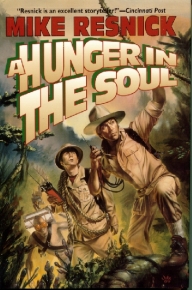
While the Julie Bell cover of the novel is accurate in its depiction, it derives a little too much from the 1930s-style adventure to really give a good feel for the novel. The reader who comes to A Hunger in the Soul expecting Indiana Jones may be disappointed that they aren't getting a dose of Harrison Ford, but what they do get is much better.
Purchase this book from 
Return to |
Reprinted from |
 .
.