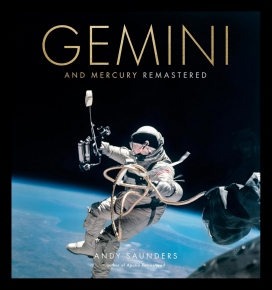
GEMINI AND MERCURY REMASTEREDBy Andy SaundersBlack Dog and Leventhal978-0-762-48834-6320pp/$75.00/September 2025 |
|
Reviewed by Steven H Silver
In 2022, Andy Saunders published a large format coffee table book entitled Apollo Remastered: The Ultimate Photographic Record, which reproduced images from the Apollo missions of the 1960s and 70s in stunning color and detail. He has now given the same treatment to the earier manned space programs in Gemini and Mercury Remastered, offering fresh views of images that are well known as well as pictures that languished in the archives. The book is a beautiful work of art detailing the United States' first steps outside the Earth's atmosphere.Saunders opens with a preface before dividing the images into chapters, mostly aligned with the individual missions, grouping the first two Mercury suborbital flights into one chapter and the remaining four orbital flights into a second chapter. The primary focus, however, is on the ten Gemini flights (with Gemini VI-A and VII combined in a single chapter). At the start of each chapter, Saunders provides a two-page outline of the mission(s), noting the equipment used, the date and length, distances flown, and brief bios of the crew members. He also offers details on the historical context for the missions, the goals for the missions, and the incidental facts, such as John Young's corned beef sandwich or the bee that joined Gordon Cooper and Pete Conrad on Gemini V. He also talks about the photos taken during the flight. While these introductions are interesting, useful, and add to the book, the real stars of the project are the photos that Saunders focuses on.
Each photo is accompanied by a caption that indicates the date and time the photo was taken, the camera and lens used, and which astronaut took the photo. Saunders also provides the context to explain what the subject of the photo is, how it fit into the mission, and the conversation the astronauts were having at the time the photo was taken to provide additional context. These captions allow the pictures to come to life in a way that just having the images would not. They become important records of the missions rather than simply amazing photographs of earth, hardware, or in a few cases, astronauts.
The book opens with fourteen photos taken during the brief flight of Alan Shepard's Freedom 7. Gus Grissom's flight on Liberty Bell 7 is only represented by seven rather grainy pictures of the recovery since his capsule sank before the cameras could be recovered. These images offer a somewhat inauspicious introduction to the book, showing Shepard in his flight suit and a couple of pictures of space or his recovery. The pictures from the other Mercury flights are similarly underwhelming until the two page spread showing sunset from orbit during Scott Carpenter's flight on Aurora 7, although most of the Mercury pictures are of the astronauts, with only a few showing the grandeur of space and an amazing picture of the Tibetan plateau taken by Gordon Cooper during Faith 7.
Once the two-man crews began to fly, it appears that photography became more important. Pictures of Ed White on his first EVA are iconic, but Saunders includes several pictures of White outside the craft that are less well known, but also give a better indication of the work White did and the motion of his tether can be seen, indicating the issues he had with it. Pictures of the Earth taken from space are always incredible and Saunders manages to bring out the vast array of colors in these images and helpfully identifies the parts of the planet which are represented. The flights of Geminis VI-A and VII allow for fantastic views of the spacecraft in orbit (as well as the famous "Beat Army" message in the window of Gemini VI-A, as well as subsequent picture sof agena rockets. Perhaps the strangest picture appears to show stars, which usually are not visible because of the brightness of foreground images, although Saunders does explain it is actually a photo of a waste dump.
The book ends with three essays detailing the birth of astrophotography, an in depth article on the photographic equipment used, making it clear that the Hasselblads most associated with the space program were only one of many cameras used, and an essay on the processes Saunders used to achieve the quality of the images that were included in the book. Taken together, especially with Jeffrey Kluger's recent look at the Gemini missions, Saunders' work offers a fresh and exciting perspective on the early days of U.S. manned space travel.
| Purchase this book |
|
|
|
|
Paperback |
Kindle |
Audio book |