
BEYOND THE GATESCatherine WellsRoc0-451-45696-3312pp/$6.99/June 1999 |
|
Reviewed by Steven H Silver
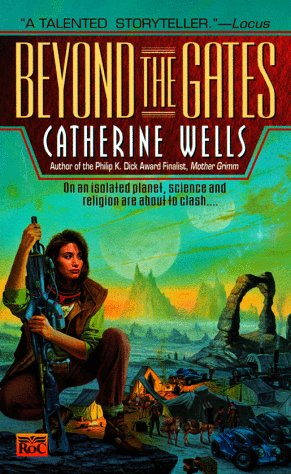
The society depicted in Catherine Wells' newest novel, Beyond the Gates, is a fundamental religious society which appears to be based on Arab culture. The Innantans have cut themselves off from the Unbelievers who reside in the rest of the galaxy except in a few instances where they need to rely on the outsiders for some essential goods or services. In Beyond the Gates, the Innantans finds that they must bring an Unbeliever palaeo-zoologist to the planet to help determine the origin of an animal found in the desert.The centerpiece of Beyond the Gates is the society Wells has created. To provide the reader with a tour of this world, Wells switches back and forth between the viewpoint of Marta, her protagonist, and Cecil Robinson, the off-world zoologist. This allows Wells to describe the society in varying amounts of detail as needed. Robinson is free to misinterpret and misunderstand what he sees while Marta is available to offer the correct analysis of the situation and describe how Innantan society functions.
Wells' plot begins by mirroring the great fossil rivalry of Cope and Marsh from the 18th century, with Robinson portraying one of the scientists and his rival, Soln Shipner taking the opposing role. As the novel progresses and Wells shows more of each of the scientists, the reader's (and Marta's) perspectives change. However, none of the characters are entirely engrossing and they seem to exist to show off first the culture of Innanta and later the wonders of the forbidden continent of Dhrusil-matkhashi.
Wells uses a frame to tell her story. While this does not appear to add much to the novel when it is introduces, as the story progresses, it becomes clear that Wells is doing two things with her frame. First, by having the caravan master Hassan relating Marta's story to his son, Ari, Wells is imparting a legendary quality to Marta's tale. The reader knows that Marta effected a major change in Innantan society even before she appears on the scene. Second, Wells is able to insert additional background information regarding Innanta at Marta's time since Hassan must provide that background to Ari as he is telling his story. Finally, by showing the story of Marta, Robinson and Shipner through their own eyes and the eyes of posterity, Wells is able to look at the way stories can be based in reality, yet change over time.
While Beyond the Gates is a reasonably straight-forward novel of discovery and adventure, Wells includes a few surprises concerning characters, both in Marta's time and in Hassan's time. None of the surprises really influences the outcome of the story, nor does Wells give clues which would allow the reader to realize these twists before they are revealed. Wells could have used them to take the reader in unexpected directions or use them to deepen her portrayals of the effected characters, but she does not choose to.
Dray's Planet and the Innantan society which exists there are interesting places which could be further developed. If Wells chooses to return to this world and its colleges, markets and forbidden continents, she surely has enough material to fill another novel. One would only hope that she would focus on characters who are more interesting and likable.
| Purchase this book |
|
|
|
Paperback |
Kindle |
Return to |
Reprinted from |


 .
.